Published on June 19, 2026
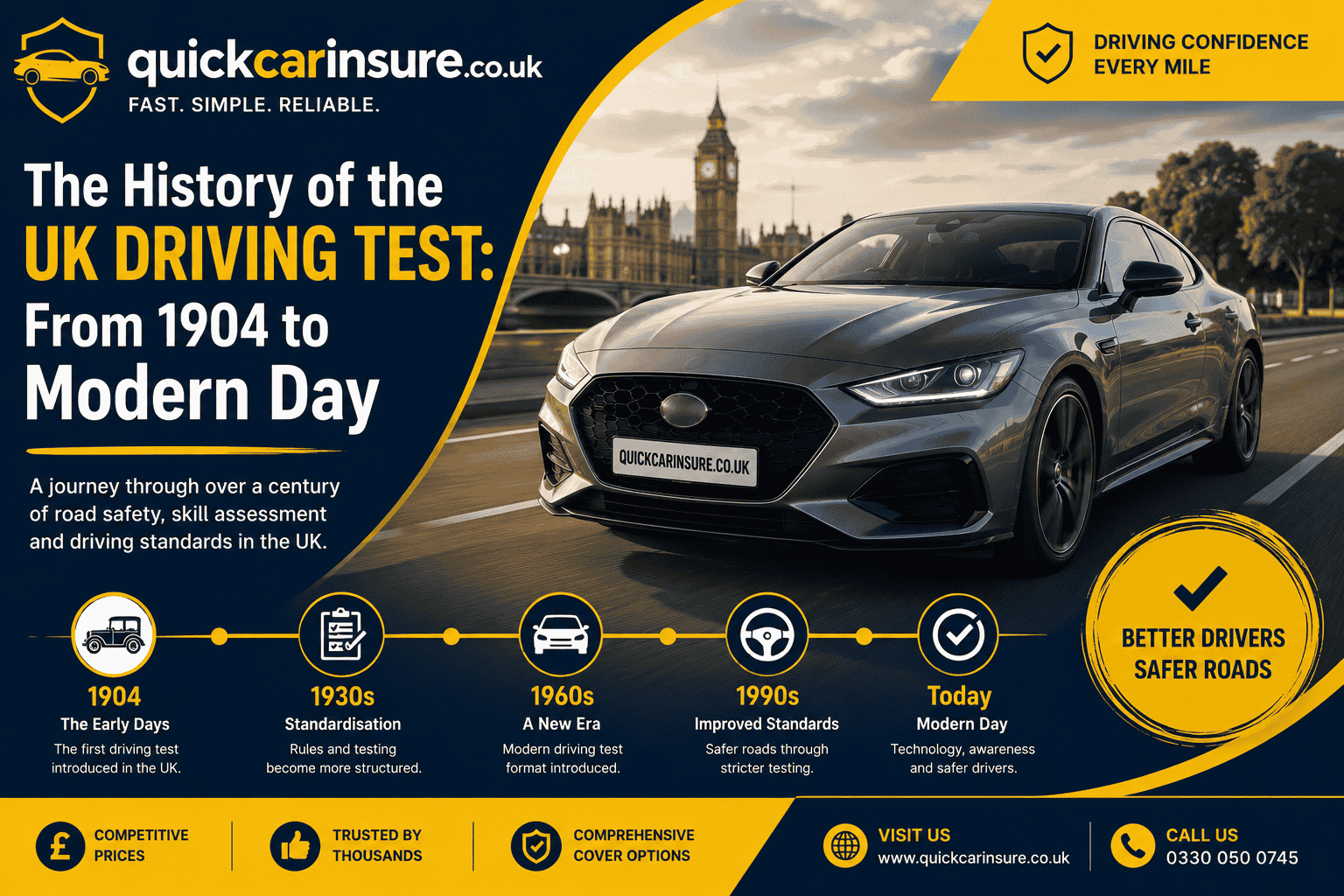
The History of the UK Driving Test: From 1904 to Modern Day
Learning to drive is one of the most exciting milestones in life. Passing your driving test gives you independence, flexibility, and the freedom to travel whenever you want. However, the driving test we know today is very different from the one drivers took decades ago.
Over the years, the UK driving test has evolved significantly to improve road safety, assess modern driving skills, and prepare motorists for real-world driving conditions. From the first driving licences issued in the early 1900s to today’s computer-based theory tests and sat-nav navigation exercises, the process has undergone major changes.
In this guide, QuickCarInsure.co.uk explores the fascinating history of the UK driving test and how it has developed into the system used today.
1904: The First UK Driving Licences
The origins of driving regulation in the UK date back to the Motor Car Act 1903, which introduced compulsory driving licences from 1904.
At the time:
- Drivers did not need to pass a test.
- Anyone over the age of 17 could apply.
- Licences were issued by local authorities.
- Annual renewal was required.
The primary goal was simply to identify motorists rather than assess driving ability.
1930: Early Road Safety Reforms
As vehicle ownership increased, so did road accidents. The government introduced the Road Traffic Act 1930, which established several important rules.
Key developments included:
- Compulsory third-party insurance.
- New driving offence regulations.
- The first official Highway Code.
- Driving assessments for certain disabled motorists.
These reforms laid the foundation for modern road safety standards.
1935: The First Compulsory Driving Test
One of the most significant milestones came in 1935, when the UK introduced mandatory driving tests.
The original test included:
- Reversing manoeuvres
- Hill starts
- Emergency stops
- Three-point turns
Despite being much simpler than today’s assessment, only around 63% of candidates passed during the first year.
This marked the beginning of formal driver competency testing in Britain.
1959: Professional Examiner Training Begins
Before 1959, driving examiners largely learned their role on the job.
To improve consistency and standards, the government opened the Stanmore Driving Examiner Training School, providing specialist training for examiners.
This helped create a more structured and fair testing system nationwide.
1964: Approved Driving Instructor (ADI) Register Introduced
As demand for driving lessons increased, the government created a formal register of qualified driving instructors.
The new system ensured that:
- Instructors met professional standards.
- Learner drivers received better training.
- Driving tuition became more regulated.
By 1970, instructor registration became compulsory.
1965: Vision Standards Become Stricter
Road safety concerns led to stricter eyesight requirements for drivers.
The government introduced a rule requiring learners to read a vehicle number plate from a specified distance before taking their test.
Today, the number plate eyesight check remains an important part of every UK practical driving test.
1996: The Theory Test Is Introduced
One of the biggest modern changes arrived in 1996 with the launch of the separate theory test.
Previously, Highway Code questions were asked during the practical test itself.
The new theory test included:
- Multiple-choice questions.
- Road safety knowledge assessments.
- Highway Code understanding.
This ensured learners demonstrated theoretical knowledge before driving independently.
2000: Computer-Based Theory Testing
As technology advanced, paper-based theory exams were replaced by touchscreen computer tests.
Benefits included:
- Faster results.
- Improved security.
- Standardised testing conditions.
The computerised format remains in use today.
2002: Hazard Perception Testing Arrives
Recognising potential dangers is one of the most important driving skills.
In 2002, the UK introduced the Hazard Perception Test, requiring learners to identify developing hazards in video clips.
Examples include:
- Pedestrians stepping into the road.
- Cyclists changing direction.
- Vehicles pulling out unexpectedly.
This addition significantly improved driver awareness training.
2003: ‘Show Me, Tell Me’ Questions Added
To ensure drivers understood basic vehicle maintenance and safety checks, practical tests began including "Show Me, Tell Me" questions.
These questions cover:
- Tyre safety.
- Lights and indicators.
- Windscreen washers.
- Oil levels.
- Vehicle controls.
Candidates can receive driving faults for incorrect answers but cannot automatically fail solely because of them.
2010: Independent Driving Introduced
The DVSA introduced independent driving exercises to test a learner’s ability to make decisions without constant guidance.
This section assesses:
- Reading road signs.
- Following directions.
- Maintaining concentration.
- Driving confidently without prompts.
Independent driving better reflects everyday motoring situations.
2017: Major Practical Test Updates
The driving test received one of its largest updates in 2017.
Changes included:
Sat-Nav Navigation
Candidates now follow directions from a satellite navigation system during part of the test.
Longer Independent Driving Section
Independent driving increased to approximately 20 minutes.
New Reversing Manoeuvres
The traditional three-point turn was removed and replaced with:
- Parallel parking.
- Bay parking.
- Pulling up on the right and reversing.
These updates focused on practical driving skills used more frequently by modern motorists.
2018: CGI Hazard Perception Clips Introduced
To improve realism and consistency, the DVSA replaced some live-action hazard perception videos with computer-generated (CGI) clips.
The updated clips feature:
- Rain and fog conditions.
- Snow and ice.
- Rural roads.
- Urban traffic situations.
This helps learners prepare for a wider range of driving scenarios.
How the Driving Test Continues to Evolve
As vehicle technology advances, the driving test continues to adapt.
Modern vehicles now include:
- Parking sensors
- Reversing cameras
- Lane assist systems
- Adaptive cruise control
- Emergency braking technology
Future driving tests may increasingly assess drivers' ability to use advanced driver-assistance systems safely and effectively.
Why Learning the History of the Driving Test Matters
Understanding how the UK driving test has evolved highlights the importance of road safety and responsible driving.
Today's learners benefit from:
- Better training standards.
- Advanced learning resources.
- Improved testing methods.
- Enhanced road safety knowledge.
While passing the test can feel challenging, the modern system is designed to create safer and more confident drivers.
QuickCarInsure.co.uk: Supporting Learner Drivers and New Motorists
Whether you're preparing for your driving test, practising with family members, or have recently passed, having the right insurance is essential.
At QuickCarInsure.co.uk, we help UK drivers find flexible and affordable insurance solutions, including temporary cover options that can support learners and newly qualified drivers as they gain valuable road experience.
Final Thoughts
The UK driving test has come a long way since the first licences were introduced in 1904. From basic driving assessments to sophisticated theory exams and hazard perception testing, every change has aimed to improve road safety and driver competence.
For learner drivers preparing to take their test today, understanding this history offers valuable insight into why modern testing standards exist and how they help create safer roads for everyone.