Published on September 13, 2026
Highway Code Stopping Distances Guide | QuickCarInsure.co.uk
Whether preparing for your DVSA theory test or refreshing your driving knowledge, understanding stopping distances is fundamental to safe driving. Maintaining an adequate gap between your vehicle and the car ahead gives you crucial reaction time to prevent collisions during sudden stops.
Staying safe on the road goes beyond sharp driving skills. Having reliable insurance coverage protects you financially if the unexpected happens. Standalone short-term policies and learner cover from QuickCarInsure.co.uk ensure you stay fully covered during private practice or borrowing a car without risking primary annual policies.
What Is Stopping Distance?
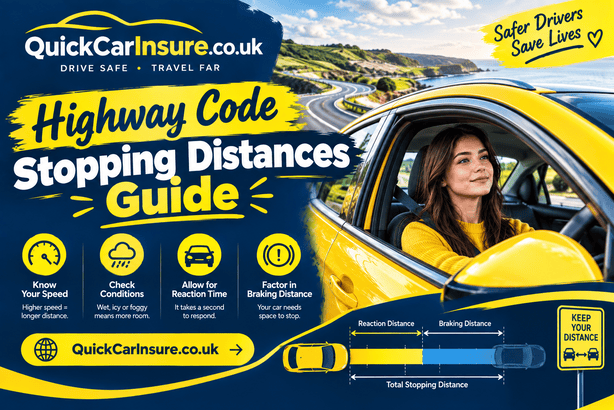
Stopping distance represents the total distance a moving vehicle travels from the moment a driver notices a hazard to the precise point where the car comes to a complete standstill.
It consists of two distinct components:
-
Thinking Distance: The distance covered while the driver perceives a hazard, processes the danger, and physically applies the brakes (average human reaction time is approximately 0.7 seconds).
-
Braking Distance: The distance travelled by the vehicle after the brakes are applied until it reaches a complete stop.
Highway Code Stopping Distances at a Glance
+------------------------------------------------------------------------------------------------+
|                             UK HIGHWAY CODE STOPPING DISTANCES TABLE                           |
+-------------------+--------------------+-------------------+---------------------+-------------+
| Speed (mph / km/h)| Thinking Distance  | Braking Distance  | Total Distance (m)  | In Feet (ft)|
+-------------------+--------------------+-------------------+---------------------+-------------+
| 20 mph (32 km/h)  | 6 metres           | 6 metres          | 12 metres           | 40 feet     |
| 30 mph (48 km/h)  | 9 metres           | 14 metres         | 23 metres           | 75 feet     |
| 40 mph (64 km/h)  | 12 metres          | 24 metres         | 36 metres           | 118 feet    |
| 50 mph (80 km/h)  | 15 metres          | 38 metres         | 53 metres           | 175 feet    |
| 60 mph (96 km/h)  | 18 metres          | 55 metres         | 73 metres           | 240 feet    |
| 70 mph (112 km/h) | 21 metres          | 75 metres         | 96 metres           | 315 feet    |
+-------------------+--------------------+-------------------+---------------------+-------------+
The Easy Formula Trick for Theory Tests
To easily calculate total stopping distances in feet for your theory test, multiply your speed in mph by a factor that increases by 0.5 for every 10 mph step:
-
20 mph $\times 2.0 = \mathbf{40\text{ ft}}$
-
30 mph $\times 2.5 = \mathbf{75\text{ ft}}$
-
40 mph $\times 3.0 = \mathbf{120\text{ ft}}$ (approx. 118 ft standard)
-
50 mph $\times 3.5 = \mathbf{175\text{ ft}}$
-
60 mph $\times 4.0 = \mathbf{240\text{ ft}}$
-
70 mph $\times 4.5 = \mathbf{315\text{ ft}}$
Factors That Increase Thinking & Braking Distances
Official Highway Code calculations assume dry road conditions, good visibility, and average car lengths. Real-world conditions often increase these numbers significantly.
Factors Affecting Thinking Distance
-
Driver Fatigue: Exhaustion slows reaction times dramatically. Take a 15-minute break every two hours during long trips.
-
In-Car Distractions: Adjusting infotainment systems, using mobile phones, or engaging in intense conversations increases thinking time.
-
Alcohol or Drugs: Impair nervous system responsiveness, increasing the distance travelled before hitting the brake pedal.
Factors Affecting Braking Distance
-
Adverse Weather: Wet roads double braking distances. Ice and snow can increase braking distances by up to 10 times.
-
Vehicle & Tyre Condition: Worn brake pads or tyres with low tread depth severely reduce grip and stopping power.
-
Vehicle Weight: Carrying heavy passengers or cargo increases kinetic energy, extending the required stopping distance.
How to Apply the 2-Second Rule
The two-second rule provides an easy method to check your safety margin on dry roads:
-
Pick a fixed overhead sign, post, or bridge ahead.
-
When the vehicle in front passes that object, count "one thousand one, one thousand two."
-
If your vehicle reaches the marker before you finish counting, you are following too closely and should drop back.
Weather Adjustment: Double the time gap to at least 4 seconds on wet roads, and increase it up to 20 seconds in icy or snowy weather.
Stay Protected with QuickCarInsure.co.uk
Whether you are gaining extra private driving practice for a test or sharing driving duties on a road trip, having legal insurance cover is essential.
Arranging flexible temporary insurance through QuickCarInsure.co.uk delivers:
-
100% Protected No Claims Discount: Separate standalone policies ensure the vehicle owner's NCD remains completely safe in the event of an incident.
-
Instant Digital Delivery: Get a quote online in under two minutes with official policy documents emailed immediately.
-
Flexible Short-Term Cover: Choose precise duration options ranging from 1 hour up to 28 days.
Frequently Asked Questions
How do stopping distances change when driving at night?
At night, lower visibility makes hazard perception harder, effectively increasing thinking distance. Ensure your speed allows you to come to a complete stop comfortably within the illuminated reach of your headlights.
What is the minimum stopping distance on wet roads?
Braking distances on wet tarmac double compared to dry surfaces. A vehicle travelling at 30 mph requires up to 46 metres to stop on wet roads compared to 23 metres on dry roads.
Will borrowing a car with temporary insurance affect the primary owner's policy?
No. Standalone temporary insurance from QuickCarInsure.co.uk operates independently, leaving the vehicle owner's existing policy and annual premiums untouched.
Practising driving or borrowing a vehicle today? Visit QuickCarInsure.co.uk to secure flexible, fully comprehensive temporary car insurance in under two minutes!